Why Safaricom and MTN Keep Losing to a Guy With a MikroTik and a Ladder

Views: 60

Why Safaricom and MTN Keep Losing to a Guy With a MikroTik and a Ladder

Why Your Neighborhood Wi-Fi Guy Is Beating Safaricom and MTN at Their Own Game

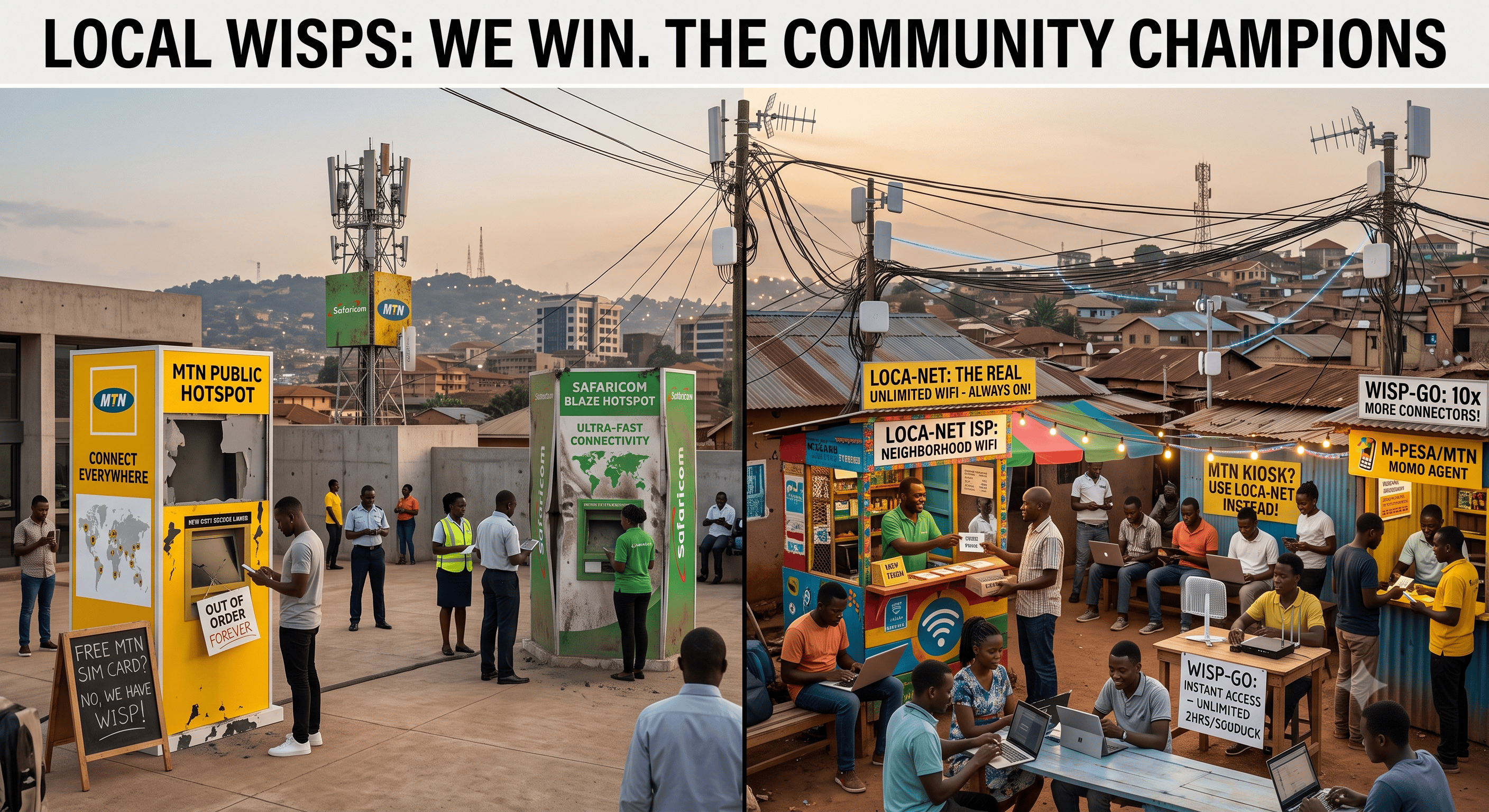
Walk through almost any estate, market, or trading center in Kenya or Uganda and you'll find a small router mounted on a rooftop, a hand-painted sign advertising "Wi-Fi 500/= per day," and a shopkeeper who'll top up your voucher on the spot. Meanwhile, Safaricom's BLive/BLAZE public Wi-Fi and MTN's public hotspot sit quietly in malls and airports, rarely mentioned, rarely used compared to the volume these grassroots networks pull in.

This isn't an accident, and it isn't because the big telcos lack the money or technology to do better. It comes down to incentives, economics, and geography four things in particular.

1. Big Telcos Are Protecting a Bigger Business

Safaricom and MTN make the bulk of their high-margin revenue from cellular data bundles. That creates a built-in conflict of interest with public Wi-Fi:

  • If they offered dirt-cheap, genuinely unlimited hotspot access everywhere, people would simply stop buying daily data bundles.
  • To avoid cannibalizing that core revenue, telco hotspot products tend to be capped, throttled, or priced in a way that doesn't seriously undercut mobile data.

Independent ISPs and street-level Wi-Fi vendors have no cellular network to protect. Selling bandwidth is the entire business, so they're free to price as aggressively as the market will bear which turns out to be very aggressive indeed.

2. The Wholesale Bandwidth Arbitrage Model

Local operators run on a simple, repeatable loop:

  1. Buy wholesale bulk. They lease a fixed fiber connection say 50–200 Mbps at business rates from a backhaul or wholesale carrier.
  2. Oversubscribe the neighborhood. Cheap hardware (MikroTik routers, directional outdoor access points) blasts that connection across an estate, market, or boda stage.
  3. Sell micro-vouchers. Access goes for KES 10–20 or UGX 500–1,000 for a few hours of high-cap or unlimited use.

Because internet usage is bursty not everyone is streaming HD video at the same second the operator can comfortably oversubscribe the line to 100+ concurrent users. That keeps prices low for customers while still generating a healthy margin for the operator. It's the same logic airlines use when overbooking seats, just applied to bandwidth.

Compare that to street vendors selling hourly access for $0.19–$0.31, against budget ISPs charging $9–$12 a month for entry-level plans a pricing structure built around what a cost-sensitive customer can actually spend right now, not around a monthly subscription commitment.

3. Placement: Corporate Coverage vs. Targeted Proximity

Where the access point sits determines who actually uses it.

  Telco Hotspots (Safaricom / MTN) Local Neighborhood ISPs
Typical locations Malls, airports, city centers, official shops, university centers Residential estates, informal settlements, local shops, markets, boda stages
Hardware High-end corporate APs, tighter range limits Long-range outdoor APs on rooftops, masts, utility poles
Sign-in Splash pages, OTPs, app logins, SIM-based checks Instant M-Pesa/MoMo STK push, or a paper voucher bought from the shop next door

Telco hotspots go where people are passing through. Local ISPs go where people are staying put home, work, the corner shop, the place they spend hours every day. That single difference in deployment philosophy explains a huge share of the usage gap.

4. Trust and a Grassroots Reseller Ecosystem

Local ISPs function less like companies and more like community franchises:

  • They partner with corner shops, cyber cafés, barber shops, and local youth to resell vouchers for a small commission distribution that's dense, personal, and everywhere.
  • When something breaks, customers message a WhatsApp group or call "the guy" who physically climbs up and fixes the AP not a corporate call center queue with hold music and a ticket number.
  • Pricing is often flexible in practice: a known customer can get credit, a discount, or a personal favor. A faceless telco billing system can't do that.

That relationship layer builds a kind of trust and stickiness that no splash-page login screen can replicate.

The Twist: Telcos Are Starting to Notice

This gap hasn't gone unnoticed. Safaricom has reportedly been developing a tokenized, pay-as-you-go home internet and public Wi-Fi product, with tokens priced as low as KES 15–100, aimed directly at undercutting the informal vendors and budget ISPs (Poa!, Mawingu, Vilcom, and others) that currently dominate low-income areas. It's a tacit admission that the micro-pricing, hyper-local model works and that beating it requires playing by the same rules the local guys already wrote.

Whether a company the size of Safaricom can actually replicate the "your neighbor fixes your router" trust factor at scale is the real open question. Infrastructure and pricing can be copied; a personal relationship with the shopkeeper down the road is much harder to manufacture from a head office.

Bottom Line

Big telcos built public Wi-Fi as a branding perk or a way to soak up excess bundle allowance for people on the move. Local ISPs and street vendors built it as their entire livelihood a high-volume, low-margin utility engineered specifically for cost-sensitive customers in high-density areas, sold by people the customer already knows and trusts. Until the telcos are willing to compete on price, placement, and relationship all at once, the neighborhood Wi-Fi guy is going to keep winning.

Related Insights

Jun 04, 2026

The launch of the National IP Peering Exchange (NIPX)

DIGITAL SOVEREIGNTY  ·  APRIL 2026 Uganda’s Internet Is Finally Coming Home The launch of the National IP Peering Exchange (NIPX) marks a turning point for Uganda’s digital economy — and a major win for every local ISP operating in the country. ●  NITA-U & Ministry of ICT    ●  Launched April 17, 2026    ●  Kampala, Uganda   ↓ Latency Local traffic speeds dramatically improved 1st Open IXP Uganda’s first neutral Internet Exchange Point FX Savings Reduced hard-currency spending on overseas routing     BACKGROUND The Traffic Boomerang Problem For years, a strange and costly thing happened every time a Ugandan accessed a government service or local website. Their data would leave Uganda, travel to servers in Europe, the United States, or South Africa — and then travel all the way back. This “boomerang” routing added latency, drove up costs for ISPs paying for international bandwidth, and left Uganda’s digital infrastructure dependent on foreign networks. The National IP Peering Exchange (NIPX) is designed to fix this. It is a neutral hub — not controlled by any single company or government entity — where ISPs, content delivery networks, cloud platforms, and government networks can exchange traffic directly, within Uganda’s borders. How Traffic Moved — and How It Moves Now Scenario Origin Route Hub Result Before NIPX Ugandan user → Overseas server High cost, high latency With NIPX Ugandan user → NIPX local hub Fast, affordable, local     “If a person in Uganda needs access to data from institutions such as URA, that data should not have to be routed through Kenya before it can be accessed. With NIPX, access happens directly within Uganda.” — Godfrey Sserwamukoko, Chairperson, Internet Service Providers Association of Uganda (ISPAU)   FOR LOCAL ISPs Six Game-Changing Advantages While NIPX benefits all digital stakeholders, the advantages for Uganda’s local Internet Service Providers are especially profound. 1. Lower Bandwidth Costs ISPs currently pay premium rates for international transit bandwidth. By keeping local traffic local, they eliminate a major line item from their operational costs — savings that can be passed directly to consumers or reinvested in network expansion. 2. Faster Speeds for Customers Shorter data routes mean dramatically lower latency. ISPs can offer genuinely faster, more responsive connections to end users without adding infrastructure. Local traffic that previously bounced through international servers can now resolve in milliseconds. 3. A Level Playing Field NIPX is a neutral, collectively governed platform. No single operator controls access, giving smaller ISPs the same peering opportunities as the largest players. This open governance model is fundamental to the platform’s design. 4. Network Resilience When international subsea cables are cut or disrupted — as happens periodically across East Africa — ISPs relying solely on overseas routing lose service entirely. NIPX ensures domestic services remain accessible regardless of what happens to international links. 5. Local Cloud Hosting Opportunity As local traffic stays local, demand for Uganda-based data centers and cloud hosting grows organically. ISPs who invest in local server infrastructure can capture entirely new revenue streams as companies seek to host content closer to Ugandan users. 6. Foreign Exchange Savings International bandwidth is purchased in hard currency. By reducing dependence on overseas routing, ISPs retain more of their earnings in Uganda shillings, improving financial stability and reducing exposure to exchange rate fluctuations. STRATEGIC CONTEXT Part of a Larger National Vision NIPX does not exist in isolation. It is a strategic deliverable under Uganda’s Digital Transformation Programme 2023–2028 and the broader Digital Uganda Vision, which aims to transform the country into a competitive regional ICT hub. ●       Digital Uganda Vision 2040 launched — Framework established to build a knowledge-based economy anchored in digital infrastructure and innovation. ●       Digital Transformation Programme 2023–2028 — IP peering identified as a key deliverable. NITA-U mandated to develop national peering infrastructure. ●       NIPX announced, April 14, 2026 — NITA-U and Ministry of ICT unveil plans at Uganda Media Centre. Stakeholders briefed on the neutral governance model. ●       Official launch, April 17, 2026 — NIPX goes live at Speke Resort Munyonyo. ISPs, content providers, and government networks invited to connect immediately.   “The NIPX is more than just a technical upgrade; it is a strategic move to position Uganda as a competitive ICT hub in East Africa. The infrastructure is expected to attract investment, support innovation, and boost the development of local digital content.” — Kabbyanga Godfrey Baluku, Minister of State for National Guidance   ACTION What ISPs Should Do Now NITA-U has called on all eligible networks to connect to NIPX and begin peering immediately. The platform’s neutral governance model means participation is open and no single competitor gains an unfair advantage by joining early — quite the opposite. The sooner an ISP connects, the sooner it begins realising cost savings and performance gains that can be passed on to customers. For ISPs who have been watching Uganda’s internet infrastructure mature from the sidelines, NIPX is the clearest signal yet that the country’s digital backbone is being built from the inside out. The question is no longer whether to join — it is how quickly. Uganda’s internet is reclaiming its sovereignty The NIPX is a historic infrastructure milestone. For local ISPs, it is also a commercial opportunity, a competitive advantage, and a chance to be part of the country’s digital future. Connect now at NITA-U.  

May 17, 2026

Starlink Finally Lands in Uganda: What It Means for Internet Access

For years, Ugandans have heard about Starlink — the satellite internet service from SpaceX — transforming connectivity in remote parts of the world. Now, after months of speculation, negotiations, and regulatory discussions, Starlink is officially coming to Uganda. The development could mark one of the biggest shifts in Uganda’s internet landscape in years. Uganda Gives Starlink the Green Light In May 2026, the Ugandan government officially approved Starlink to operate in the country after reaching an agreement with the Uganda Communications Commission (UCC). The deal followed extensive talks around licensing, taxation, national security, and compliance with local telecom laws. Government officials described the agreement as a major step toward expanding internet access across the country — especially in regions where traditional telecom infrastructure has struggled to reach. Before the approval, Starlink had faced regulatory resistance. Earlier in the year, Ugandan authorities warned citizens against using unauthorized Starlink equipment because the company had not yet received an operating license. That situation has now changed. Why Starlink Matters in Uganda Internet access in Uganda has improved significantly over the past decade, but large gaps still remain. In many urban areas like Kampala, users can access fiber internet and relatively strong 4G or 5G networks. But in rural districts, connectivity is often slow, expensive, or unavailable altogether. That’s where Starlink becomes interesting. Unlike traditional internet providers that rely on cell towers or underground fiber cables, Starlink uses thousands of low-Earth orbit satellites to deliver broadband internet directly to a small dish installed at a home, school, or business. This means places that were previously difficult or expensive to connect could suddenly gain access to high-speed internet. Potential beneficiaries include: Rural schools needing online learning tools Health centers requiring telemedicine access Farmers using digital market platforms Remote businesses and tourism lodges NGOs and humanitarian operations Content creators and remote workers outside major cities Could Starlink Change Internet Prices? That’s the big question. Uganda’s internet market is currently dominated by major telecom providers like MTN Uganda and Airtel Uganda. These companies already serve millions of users through mobile data and fiber services. Starlink’s arrival introduces a new kind of competition. While Starlink is unlikely to replace mobile internet for most people anytime soon, it could pressure providers to improve speeds, reliability, and pricing — especially for home and business broadband customers. However, affordability may still be a challenge. In many African countries where Starlink already operates, the initial hardware kit can cost several hundred dollars, with monthly subscriptions also priced higher than standard mobile bundles. Uganda’s official pricing has not yet been fully announced, but many observers expect cost to be one of the biggest barriers to widespread adoption. Where to Buy Starlink in Uganda As Starlink officially enters Uganda, customers are expected to purchase kits through: Authorized local resellers and technology stores Online ordering through the official Starlink website Selected internet and ICT service providers Installation partners offering setup services for homes and businesses Customers should always confirm that the seller is authorized and that the equipment is genuine before making payment. For inquiries, installation assistance, or Starlink updates in Uganda: WhatsApp: https://wa.me/256763206676 The Bigger Picture: Africa’s Internet Race Uganda joins a growing list of African countries embracing satellite internet technology. Across the continent, governments are under pressure to close the digital divide and improve access to education, e-commerce, fintech, and digital public services. Reliable internet is increasingly viewed as essential infrastructure — just like roads and electricity. Starlink’s expansion into Uganda reflects a broader trend: global tech companies are seeing Africa as a major growth market for connectivity. At the same time, regulators are trying to balance innovation with concerns about sovereignty, taxation, cybersecurity, and market fairness. What Happens Next? Several details are still expected in the coming months: Official Ugandan pricing for Starlink packages Retail and installation partnerships Importation procedures for Starlink kits Coverage expansion timelines Customer support structures inside Uganda For now, one thing is clear: Uganda’s internet sector is entering a new phase. Whether Starlink becomes a niche premium service or a true connectivity revolution will depend on pricing, accessibility, and how quickly the company can scale across the country. But after years of waiting, the satellite internet era has officially arrived in Uganda.

May 23, 2026

Inside AI Everything Kenya x GITEX Kenya 2026

Nairobi Becomes Africa’s New AI Hotspot  The global tech giant GITEX has officially landed in East Africa, and Nairobi is now at the center of one of Africa’s fastest-growing AI conversations. AI Everything Kenya x GITEX Kenya 2026 brought together startups, investors, policymakers, students, developers, and global technology companies for a three-day summit focused on artificial intelligence, cybersecurity, fintech, cloud computing, agritech, and digital transformation. Hosted between the Sarit Expo Centre and the Kenyatta International Convention Centre, the conference attracted participants from more than 75 countries and thousands of attendees across the African tech ecosystem. Speaker Lineup Highlights Several high-profile speakers, founders, investors, and policymakers attended the summit to discuss Africa’s AI future. Notable voices at the event The lineup included: African venture capital investors Fintech founders AI researchers Kenyan government technology leaders International AI and cloud executives Companies and organizations represented Major organizations mentioned across event coverage included: IBM Mastercard Glovo Italian Trade Agency KAOUN International One of the most talked-about sessions focused on how Africa can build AI systems designed for local languages, agriculture, education, and financial inclusion instead of depending entirely on imported models. Startup Competitions and Innovation Challenges Supernova Challenge One of the biggest attractions at GITEX Kenya was the Supernova Challenge, Africa’s major startup pitch competition connected to the wider GITEX network. What startups competed for USD 30,000 equity-free funding Exposure to international investors Opportunities to pitch globally Access to the GITEX global finals Glovo PowerUp Award Food delivery and tech company Glovo also launched a startup support initiative during the conference. A Kenyan startup won a fully funded innovation residency in Barcelona through the Glovo Kenya PowerUp Award 2026. The award highlighted how international companies are beginning to invest more heavily in Kenyan AI and startup talent. Kenyan Companies and Innovators Attending Kenyan startups and innovators were among the strongest participants at the summit. Areas where Kenyan startups stood out AI for healthcare Sign-language AI tools Fintech and digital payments AI-powered education systems Agritech automation Local-language speech technology Kenyan innovation projects gaining attention Some of the most exciting discussions included: AfriVoices-KE, a multilingual Kenyan speech dataset supporting African language AI systems AI-powered medical education tools built for low-resource Kenyan schools and universities AI moderation and peacebuilding research developed collaboratively by African researchers The event showed that Kenya is not just consuming AI technology — it is actively building solutions for African problems. Opportunities for Students and Developers Why students should care For students interested in: software engineering, cybersecurity, machine learning, robotics, data science, UI/UX, or startups, this conference became one of the best networking opportunities in East Africa. Many students attended specifically to: meet mentors, get internship opportunities, discover scholarships, learn AI tools, and connect with startup founders. Developer Opportunities at GITEX Kenya Workshops and technical sessions Developers attending the event gained access to: AI workshops cybersecurity simulations startup demo sessions cloud and infrastructure talks investor networking opportunities Career opportunities The summit also created opportunities for: internships startup hiring hackathons accelerator programs remote AI jobs open-source collaborations Many startups were actively searching for: frontend developers AI engineers cloud specialists prompt engineers product designers data analysts Why This Event Matters for Africa AI Everything Kenya x GITEX Kenya is more than just another tech conference. It signals a major shift: Nairobi is becoming a continental AI hub. African startups are attracting global investors. Local-language AI is gaining momentum. Students now have direct access to global tech ecosystems. International tech companies increasingly see Kenya as a strategic innovation market. As AI adoption grows across Africa, events like GITEX Kenya could play a major role in shaping the next generation of African developers, founders, and digital creators.